
Xinhuanet | Hospitals Interview Their AI Agent Workforce as AI Tackles Operational Pain Points in Healthcare
PalClaw, the intelligent agent, is designed to address two major challenges: the failure of large healthcare AI models to move from concept to practice, and the shortage of hybrid operations talent. Nearly one hundred Grade III Class A (tertiary) hospitals and several hundred hospital administrators attended the event, posing questions to PalClaw on concrete scenarios such as how to improve surgical performance and schedule attending physicians, effectively conducting a live interview of the AI agent workforce.
Source: Xinhua News Agency. Reporter: Chen Xiaoyu
Overview

Shanghai, 18 April (Reporter: Chen Xiaoyu). Shanghai Penghai Laixun Data Technology Co., Ltd. (Palline) has recently launched PalClaw, an AI agent workforce purpose-built for hospital operational management. The product addresses two major challenges: the under-utilization of medical large models and the shortage of operations talent with cross-disciplinary expertise. The launch event drew nearly 100 Grade III Class A (tertiary) hospitals and several hundred managers of primary-care institutions from across the country, who put PalClaw to the test in real time by posing scenario-based questions on topics such as surgical performance management and attending-physician scheduling.
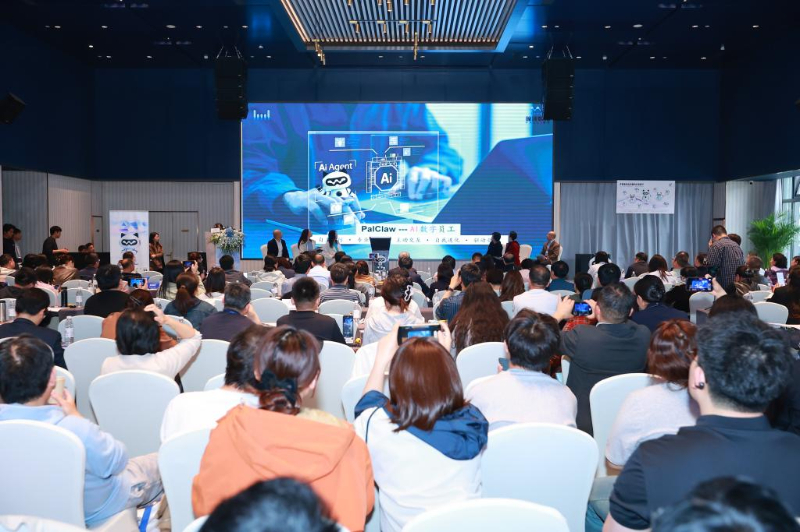
At the launch event, an interactive aerial holographic projection displayed PalClaw's virtual avatar. "Xiao Peng, here is a hospital case for you — should this hospital introduce a weekend-surgery programme?" When a guest posed the question, PalClaw, activated by the wake word "Xiao Peng", responded immediately: "My core recommendation is that, at this stage, a dedicated incentive scheme for weekend surgery should not be pursued. The principal reason is that the precondition for weekend surgery is full utilisation of weekday surgical capacity…" A complete proposal was generated on the main screen in real time.
"Whether or not to use AI in hospital operational management is no longer a choice — it is a must." Xue Wanguo, vice-chair of the Information Technology Committee of the Chinese Hospital Association, noted that information systems now cover virtually all hospital business processes, and that the focus of informatisation has shifted from data capture to data governance. The digital infrastructure for specialty-level hospital operations has long been constrained by knowledge barriers and a shortage of cross-disciplinary talent. The rise of artificial intelligence offers a new pathway to data-driven hospital operational decision-making.
Wang Zhigang, founder and CEO of Palline, observed that conventional hospital operations thinking tends to focus on scaling metrics such as admissions, revenue and surgical volume, yet the larger these volumes become, the more fatigued clinical staff become and the higher the risks, leaving the underlying case mix difficult to optimise. The ultimate goal of healthcare operations, he added, should be to reduce patient suffering and recurrence and to help patients return to normal life wherever possible. AI, he said, can serve as a capable assistant that understands clinical protocols, is adept at data analysis, and can identify opportunities for cross-specialty collaboration.
It is understood that, in recent years, major healthcare institutions have been deploying large models at scale, but conventional large models lack deep adaptation to medical operations scenarios, making it difficult to translate vast volumes of data into actionable decision support. At the same time, applications based on autonomous-agent technologies such as OpenClaw face the dual barriers of high deployment costs and data-security compliance, given the sensitivity of medical data. Palline's AI agent workforce, PalClaw, is built on long-term service insights gained from more than 700 healthcare institutions. It requires no significant additional computing investment from hospitals, integrates quickly with existing core systems such as HIS, LIS and SPD, and safeguards security through data desensitisation and role-based access controls. Pilot data show that the product improves the efficiency of hospital operations data insight by 92%, reduces manual operations workload by more than 70%, and effectively lowers both staffing and management costs.
(Editor: Zhu Hong)