
PalClaw, the healthcare operations agent
Ontology-driven professional intelligence for healthcare operations management. It moves beyond executing tasks to proactively improving toward operations goals: proactive, operations-savvy, closed-loop and able to grow.

Three pain points in healthcare operations management
Slow access to data
Data is scattered across core business systems in different departments, and coordinating data requests often takes a long time.
Knowledge tied to individuals
Reasoning and judgment criteria depend on individual staff experience; when someone changes roles, continuity breaks, and knowledge is hard to capture and reuse.
AI struggles to fit how healthcare providers really work
Without provider-specific corpora and an operations ontology, AI often finds it hard to take on real work.
PalClaw: an operations improvement loop that traces root causes through business objects
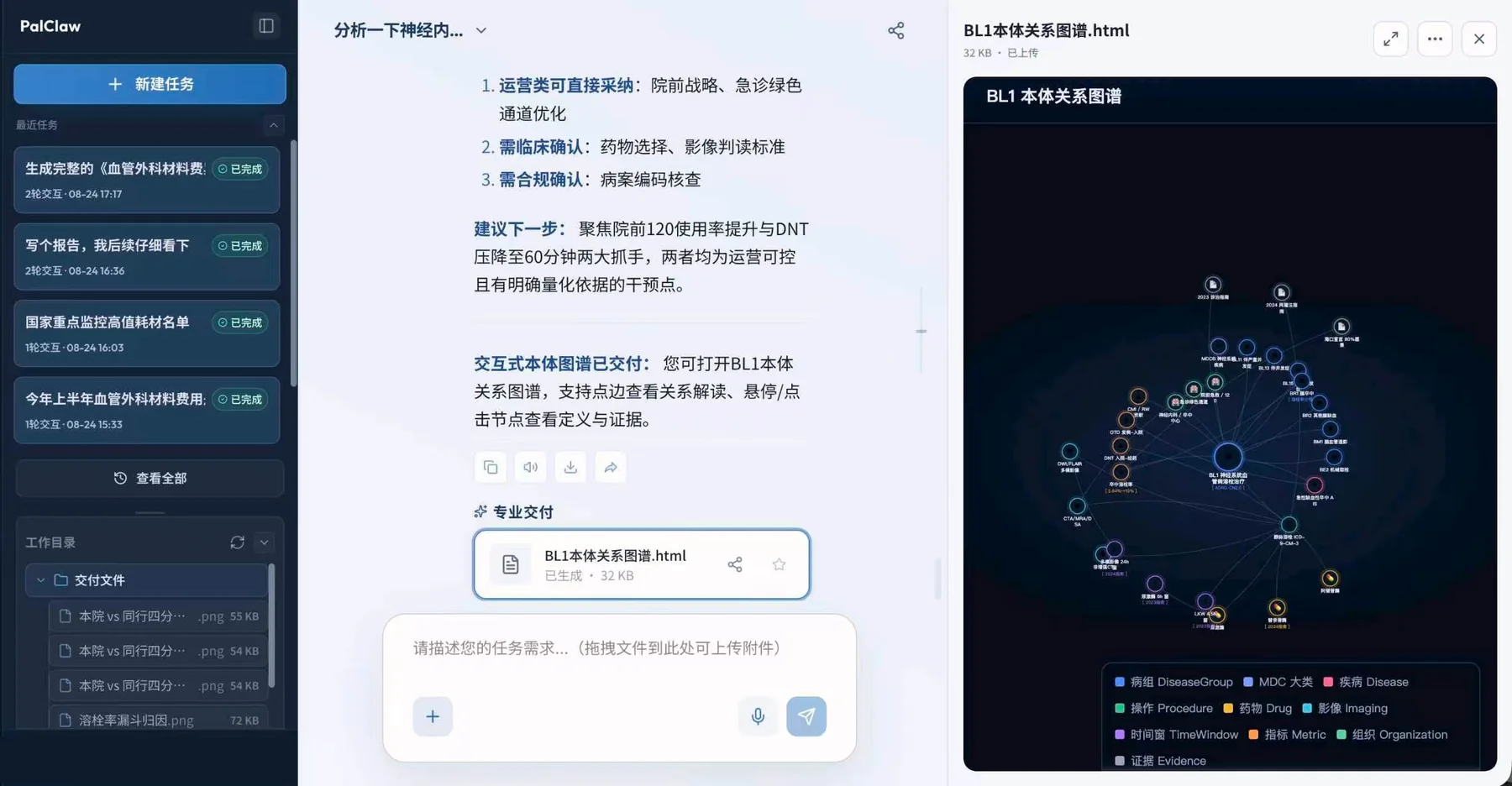
Starting from a core business object, PalClaw retrieves the related diseases, diagnostic and treatment techniques, clinical pathways, resources and capacity, quality metrics, operations metrics and evidence sources, forming an explainable network of business relationships. It then identifies the metric definitions to use, benchmarks against in-house data and industry baselines, pinpoints the gaps, and traces bottlenecks to their causes across process, resources, quality, coordination and other dimensions.
Four steps in a chain
- 1Lock onto the business object
- 2Retrieve related metrics
- 3Align definitions, benchmark against baselines
- 4Pinpoint bottlenecks, recommend actions

PalClaw
Operations ontology: business objects and their relationships
Case-mix groups
- Core ontology objects
- DRG grouping · ADRGs (adjacent DRGs) · clinical coding
- What it drills into
- Cost by case type · charges by case type · margin by case type · volume and price mix · drugs and consumables per case
Resources
- Core ontology objects
- Patients · staff · equipment · beds · consumables · operating rooms
- What it drills into
- Patient mix and referral sources · bed efficiency · OR efficiency · equipment utilization · staffing · drug and consumable share
- Typical scenario
- Case-mix groups use resources differently → optimizing surgical slots, beds and nurse staffing
Performance
- Core ontology objects
- Professional fee (PF) · DRG · workload · work value
- What it drills into
- Physician performance · nursing performance · clinical support staff performance · performance-related pay · linked to goals
- Typical scenario
- Valuing clinicians' work fairly, based on workload evaluation
Goals
- Core ontology objects
- Strategic goals · budget goals · disease-specific goals · quality goals
- What it drills into
- Four dimensions: business scale · cost level · quality and safety · operating efficiency
- Typical scenario
- Goals are tied to budget management and performance pay, and become the basis for resource allocation and appraisal
PalClaw 2.0 capability loop
- Proactive interaction→
- Professional intelligence→
- Task closure→
- Continuous evolution
Unified definitions · root causes found · actionable conclusions
From request to result, end to end
- 1State the needIn natural language
- 2Execute autonomouslyBreakdown · analysis · visualization
- 3Deliver resultsCharts + reports + files
- 4Store locallyReusable and traceable
- 5Operate continuouslyMonitoring · alerts · reviews
PalClaw: four core abilities
Built around the task flow: from request to delivery, end to end.
Disease-specific operations: from general operations to fine-grained disease-specific management
On top of the PalClaw agent platform, disease-specific operations are broken down further into configurable work modules that support in-depth analysis. For priority areas such as cerebrovascular disease, cardiovascular disease, bone and joint disease and cancer, this forms a configurable, upgradable product line for disease-specific operations.
Centered on each disease, organized by ADRG (adjacent DRG)
The AI Workforce for disease-specific operations
- 01Case-mix forecasting
- Case-mix group structure scan
- Epidemiological forecasting
Analyzes the structure of priority ADRGs to identify high-value case-mix groups with room to grow, and runs epidemiological forecasting upstream.
- 02Case-mix resource planning
- Bed-days
- Surgical time
- Staffing
Calculates the bed-days, surgical time and staffing each case-mix group needs (bed-days = expected length of stay (ELOS) × discharges).
- 03Operations analysis and recommendations
- Key evidence
- Risk alerts
- Improvement levers
- Recommended actions
Drills down into case-mix groups, techniques, drugs, consumables and metrics to trace causes, and delivers key evidence, risk alerts, improvement levers and recommended actions.
Provides dedicated quality indicator definitions and interpretation rules, and integrates with PalClaw's monitoring tasks for continuous monitoring.
Modular disease-specific delivery
Delivered by case-mix group, forming a product line for priority areas.
Smart triggering
Started in natural language; the system automatically recognizes disease-specific management intents.
Operations dashboard
Disease-specific entry points + quick actions + history.
Professional report delivery
Leadership briefings and analysis reports, with preview and archiving.
Final judgment still rests with professionals, but the ontology's definitions and the accumulated methods are what keep the agent on course as it runs.
Your organization's capabilities, reinforced by AI
- 01
Faster decisions
Hand data queries to PalClaw and spend more time on clinical communication and management decisions.
- 02
Knowledge retained
Individual experience is captured as reusable operations assets, and the agent helps staff get up to speed quickly.
- 03
Safe and secure
Supports on-premises deployment with locally hosted large models; data stays on your premises and every action is traceable.